Modes sound complicated, but you probably already know two of them. Ionian is the major scale and Aeolian is the natural minor scale. The other modes give you different versions of the familiar major and minor sounds.
A useful way to think about modes on guitar is in two main families - one sounding major and based around the major pentatonic scale; one sounding minor and based around the minor pentatonic scale. There is also a seventh mode, Locrian, which is built around a diminished sound and is less commonly used.
Major - Lydian, Ionian and Mixolydian
Minor - Dorian, Aeolian and Phrygian
Diminished - Locrian
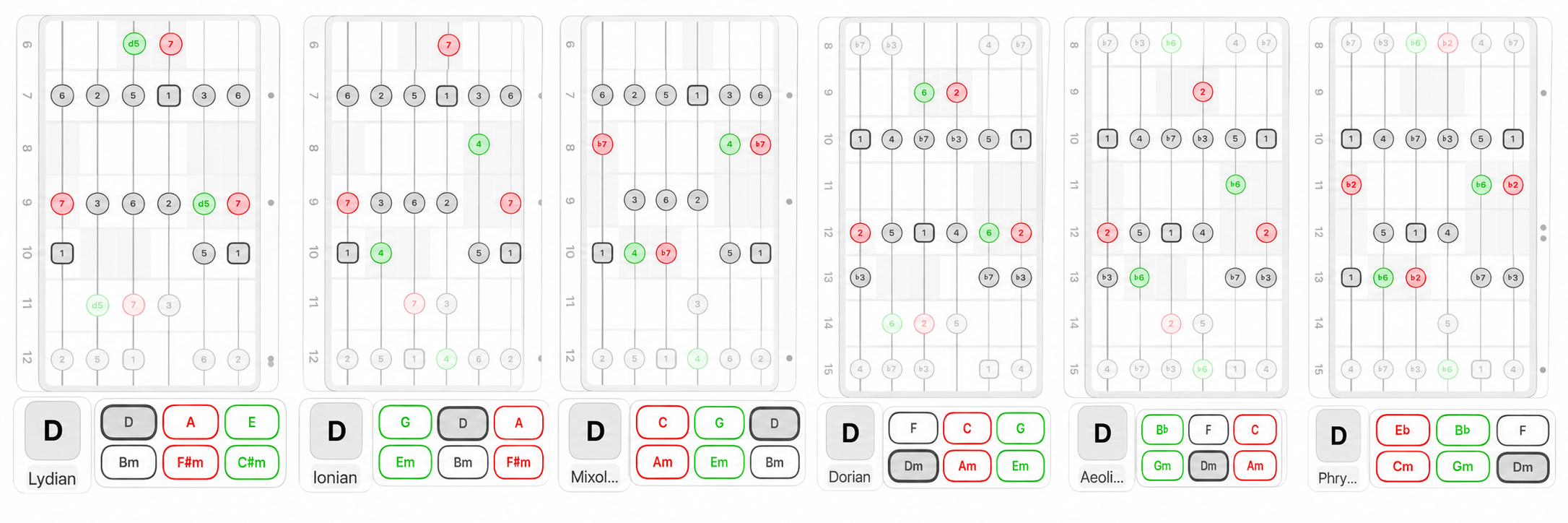
The diagram shows how you can add two notes to the pentatonic scale to create a mode. It keeps D as the tonal centre — the note that sounds like home — with the two added notes (red and green in the diagram) giving each mode its character:
Lydian — bright, open and slightly dreamy
Ionian — the familiar major sound
Mixolydian — major with a bluesy or rock feel
Dorian — minor, but brighter and more uplifting
Aeolian — the familiar minor sound
Phrygian — dark, tense and slightly exotic
Thinking of modes as pentatonic scale + red/green notes helps you see which notes give each mode its character. It also means there are not seven completely new patterns to learn.
But playing the scale notes is only part of creating a modal sound. The chords underneath are important too. They help keep the tonal centre sounding like home and bring out the notes that make each mode distinctive.
For example, start with D minor pentatonic and add E (red) and B (green) to get D Dorian. The B is particularly important because it gives Dorian its brighter minor character. Try playing these notes over a simple Dm–G progression and listen to how they change the familiar minor pentatonic sound.
You do not need to memorise every mode to start using them. Exploring modes can add new sounds to your playing, but it can also help you understand how scales, intervals and chords fit together.
Try it for yourself in Scale Wizard. Keep the same tonal centre and switch between modes to see exactly which notes change. Select a chord to see its notes and how its character changes in the context of each mode.