Understanding the Circle helps you:
* See which chords belong to a key and the role each chord plays
* Recognise common chord progressions such as I–IV–V, I–V–vi–IV and ii–V–I
* Move a song into a different key while keeping the same progression
* Spot when a song uses a chord from outside the key
What is the Circle of Fifths?
The Circle of Fifths arranges the 12 notes so that each step clockwise moves up by a fifth (on the guitar, that is 7 semitones/frets).
Each note can also be the root of a chord. Chords that are closely related sit together on the Circle, making it easy to see which chords belong to a key.
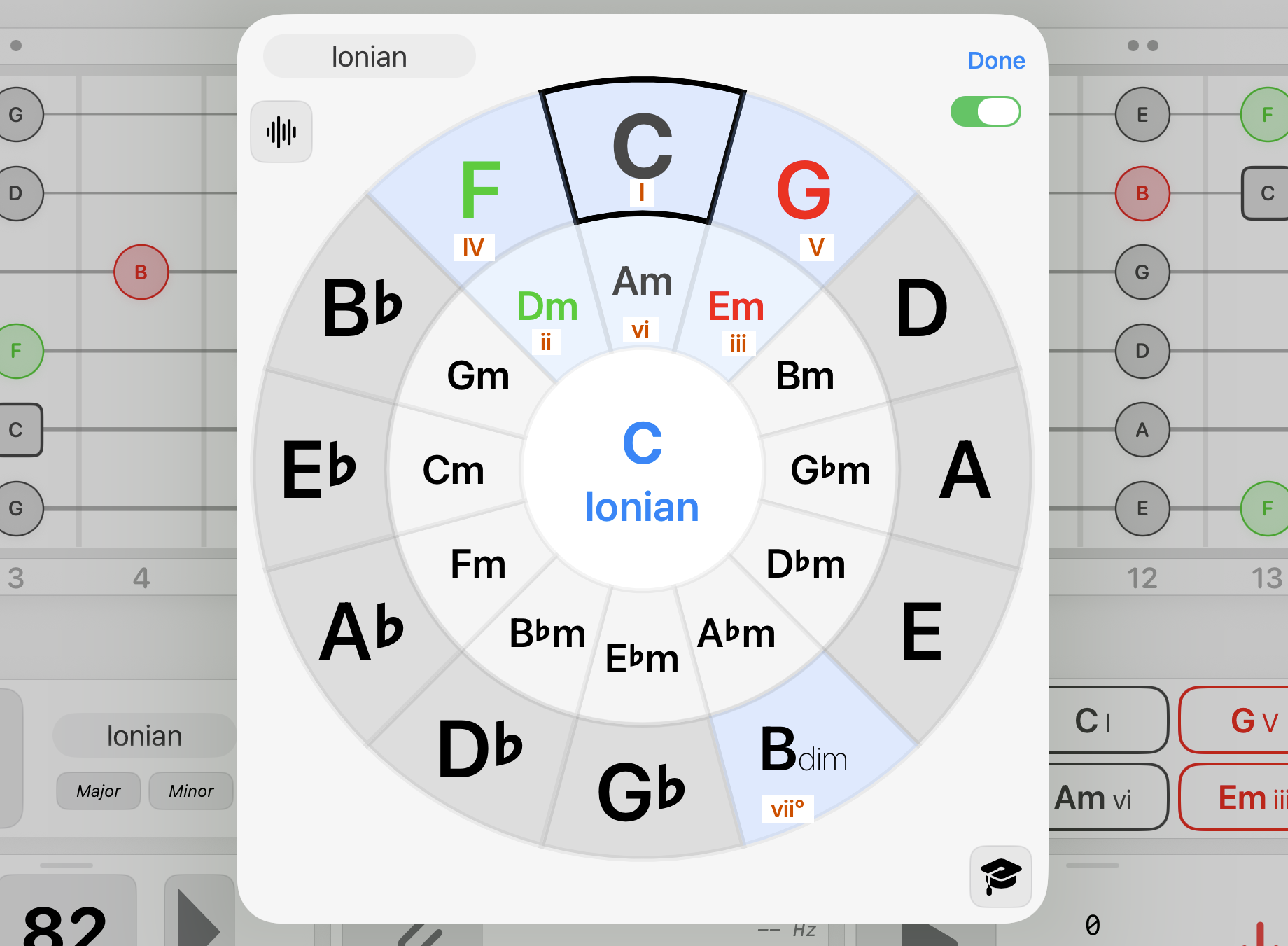
In the diagram, look at C major (Ionian). C sits between F and G.
These are the three major chords in the key. They are labelled:
IV — F
I — C
V — G
The inner circle shows their relative minor chords:
ii — Dm
iii — Em
vi — Am
These are the six main chords in the key. The seventh, vii°, is diminished. It shares no notes with C (or Am) and sits separately in this grouping, while its notes create a strong pull back towards C. This gives it a tense, unsettled sound, so it is used less often than the other six.
Roman Numerals
The Roman numeral is the chord’s degree — its position within the key. Upper-case numerals are major chords and lower-case numerals are minor chords. More importantly, the degree tells you the role the chord plays.
For example, I–IV–V is C–F–G in C major, but G–C–D in G major. The chord names change, but their roles and relationships stay the same. This makes chord progressions much easier to recognise, understand and transpose to another key.
Major and Relative Minor
Every major key also has a relative minor built from the same notes. In C major, that is A minor. C and Am share two of their three chord tones, so they are closely related.
Songwriters often use the relative minor chord to introduce a minor flavour or change of mood while remaining closely connected to the major key.
Once you start thinking in chord degrees rather than just chord names, many songs begin to reveal the same familiar patterns.
Scale Wizard
Use the Circle of Fifths to select a key and explore the chords that belong to it. Start thinking in terms of chord degree and chord function.
Use Chord Recognition to analyse your music. Live analysis identifies the chords being played and shows the chords and key on the Circle of Fifths.