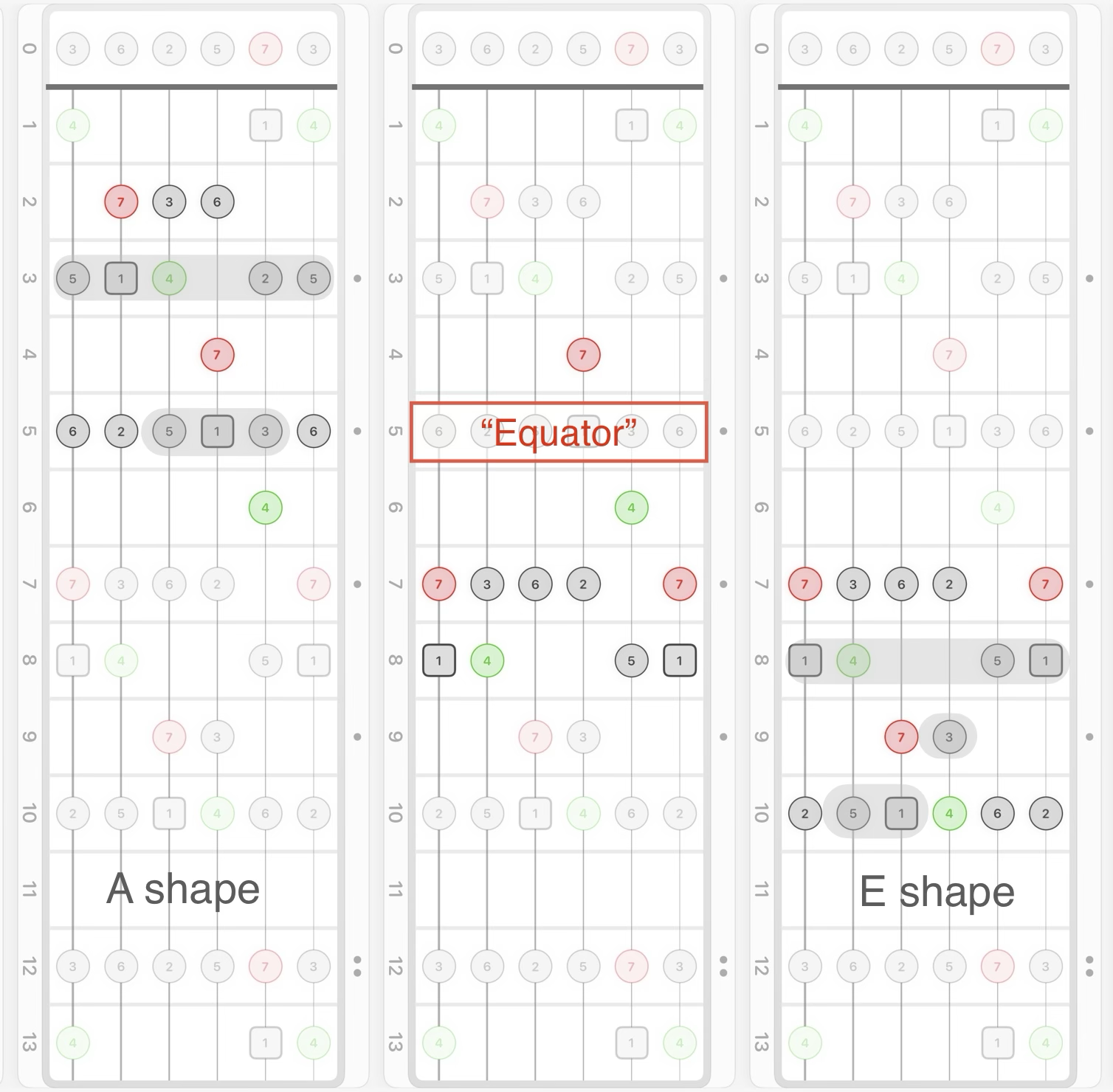
Don’t think of chords and scales as separate things. When you learn a scale pattern, learn to see the chord shapes inside it. This makes it easier to find chord tones when improvising and to add fills while playing chords.
A simple place to start is the “Equator” — the row of notes where Pentatonic Positions 5 and 1 meet. The bottom of the A shape sits on this row, giving you an easy visual landmark.
This A shape is the tonic (I) chord and uses intervals 1, 3 and 5 from the scale. Using the same intervals a few frets below, you can also find the E shape. This is a different voicing of the same tonic chord.
“Equator” is not musical terminology — it is simply a way to visualise the fretboard. Once you recognise it, other landmarks become easier to see too, such as the triangle formed by the first three strings of the D shape.
The same idea works for other chords in the key:
- Add the green notes (interval 4) to the pentatonic scale and you can find the IV chord: intervals 4, 6, 1.
- Add the red notes (interval 7) to the pentatonic scale and you can find the V chord: intervals 5, 7, 2.
Minor chords are there too, using shapes such as Am, Em and Dm.
This is a relative way of seeing the fretboard. Instead of learning chords as isolated names and positions, you learn where they sit in relation to the tonic and the scale. You begin to think of chords as I, IV, V, ii, vi… rather than just by their individual names. This makes it easier to recognise and play the same chord relationships in any key.
The idea is simple, think of scales and chords as one connected fretboard pattern. To see how other chord degrees fit within the scale, try Scale Wizard.