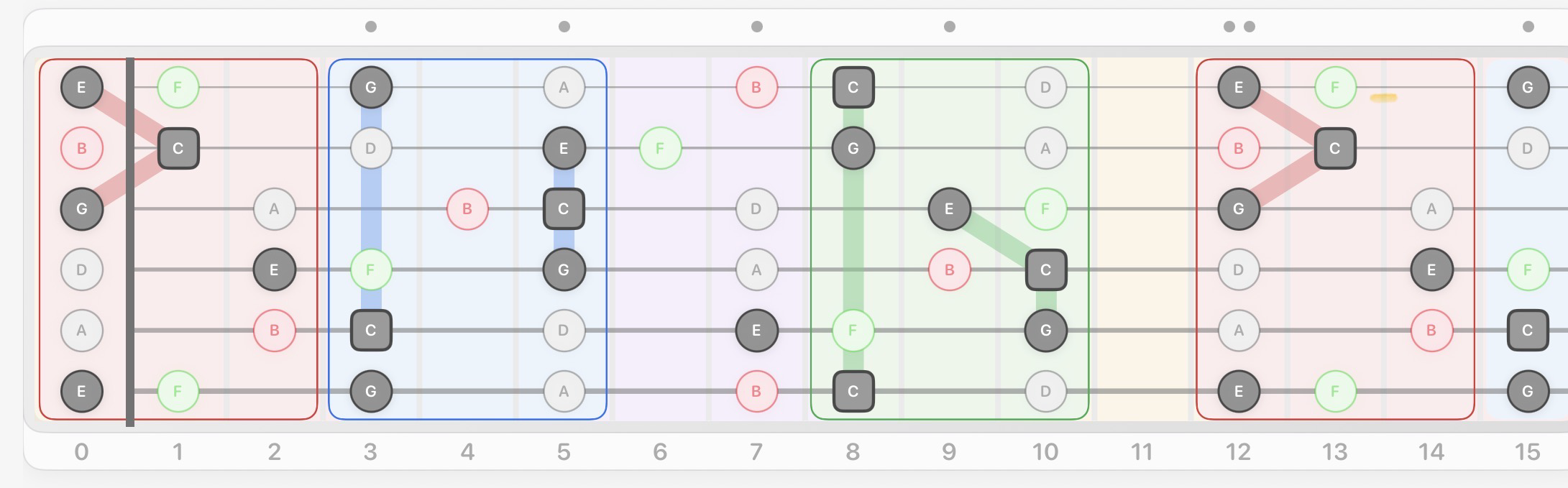
CAGED takes chord shapes you already know and turns them into a map of the fretboard. It shows how you can play a chord using shapes C, A, G, E and D.
Often a barre (1st finger fretting many strings) is used to fret strings that would otherwise be open. But it is easier, and often better, to play without a barre and only strum some of the strings.
The diagram shows different ways to play the C chord. It is easiest to see (and play) using the A shape with a barre on the 3rd fret, or an E shape with a barre on the 8th fret. You can also see the triangle of the D shape on the 12th fret.
Each position gives you a different voicing. Using higher or lower pitch notes, or have a different note as the lowest of the chord (bass note). This gives more ways to follow the movement of a song.
Remember, you do not need to play all the strings. A chord can be played by just combining 3 tones (scale intervals 1, 3, 5). Combining these 3 different tones gives you a triad. In the diagram, notice how the CAGED shapes give you many different triads across 3 adjacent strings.
Notice also that the shapes overlap. They aren’t five separate boxes — together they show how the same chord continues across the fretboard. It may be easier to start out learning only the E, A and D shapes.
Try it for yourself in Scale Wizard. Play a chord and see how the CAGED shapes appear across the fretboard. Use Guided Practice to learn the positions and measure your progress.